Feminism has long been incorporating economic issues into its agenda. This is evident from the pioneering work of those who analysed the gender dimension in development debates1, to the pioneering voices from the Global South that pointed out the risks of the marketisation of governance (Taylor 2000), to the current discussions on the challenges that global financial capitalism imposes on any political programme for equality and justice (Benería et al. 2016; Sibeko 2019, 2023; Simeoni 20212). A current discussion in feminism pertains to the different possible mechanisms for financing development. The notion of financing for development refers to the mobilisation of resources that allow two issues to be addressed simultaneously: to provide for the economic and social needs that will improve the material living conditions of the population and to create the necessary structures for lasting and sustainable economic development.
feminist

Africa
Past Issue
Feminist Africa Volume 4, Issue 2 (2023)
Public-Private Partnerships and Development in Africa
Feminist Contestations

Content
Editorial
Editorial: Public-Private Partnerships and Development in Africa: Feminist Contestations
Feature
Public-Private Partnership: A Landmark of Mainstream Development Discourse and Why Feminists Should Worry
Overview of Public-Private Partnerships in Sub-Saharan Africa: Emerging Risks and Narratives
Public-Private Partnerships, Gender Equality, and Women’s Rights in Sierra Leone: A Focus on Addax Bioenergy
A Gendered Approach to Public-Private Partnerships in University Student Housing Provision – The Case of South Africa
Accounting for Class and Feminist Political Economy: Questions Emanating from Ghana’s Market PPPs
Standpoint
The Public-Private Partnerships Dilemma in Uganda
In Conversation
Public-Private Partnerships in the Health Sector Cannot Guarantee Equity in Access to Health: The Initiative for Social and Economic Rights Takes on the Ugandan Government
Profiles
The Nawi Afrifem Collective: Bringing a Pan-African Feminist Voice to Macro-Level Economic Narratives in Africa
Reviews
African Women in Digital Spaces Redefining Social Movements on the Continent and in the Diaspora by Msia Kibona Clark and Wunpini Fatimata Mohammed. Dar es Salaam: Mkuki na Nyota Publishers Ltd, 2023
Surfacing: On Being Black and Feminist in South Africa, edited by Desiree Lewis and Gabeba Baderoon. Johannesburg: Wits University Press, 2021
Tributes
Tribute to Professor Ama Ata Aidoo
Ama Ata Aidoo: The Pioneering Writer from Ghana left Behind a String of Feminist Classics
Contributors
Back Cover
Issues 1 & 2 from Volume 5
-
Pan-African Feminist Popular Education
This issue centers on Pan-African feminist popular education in Global Africa as a liberatory force…

-
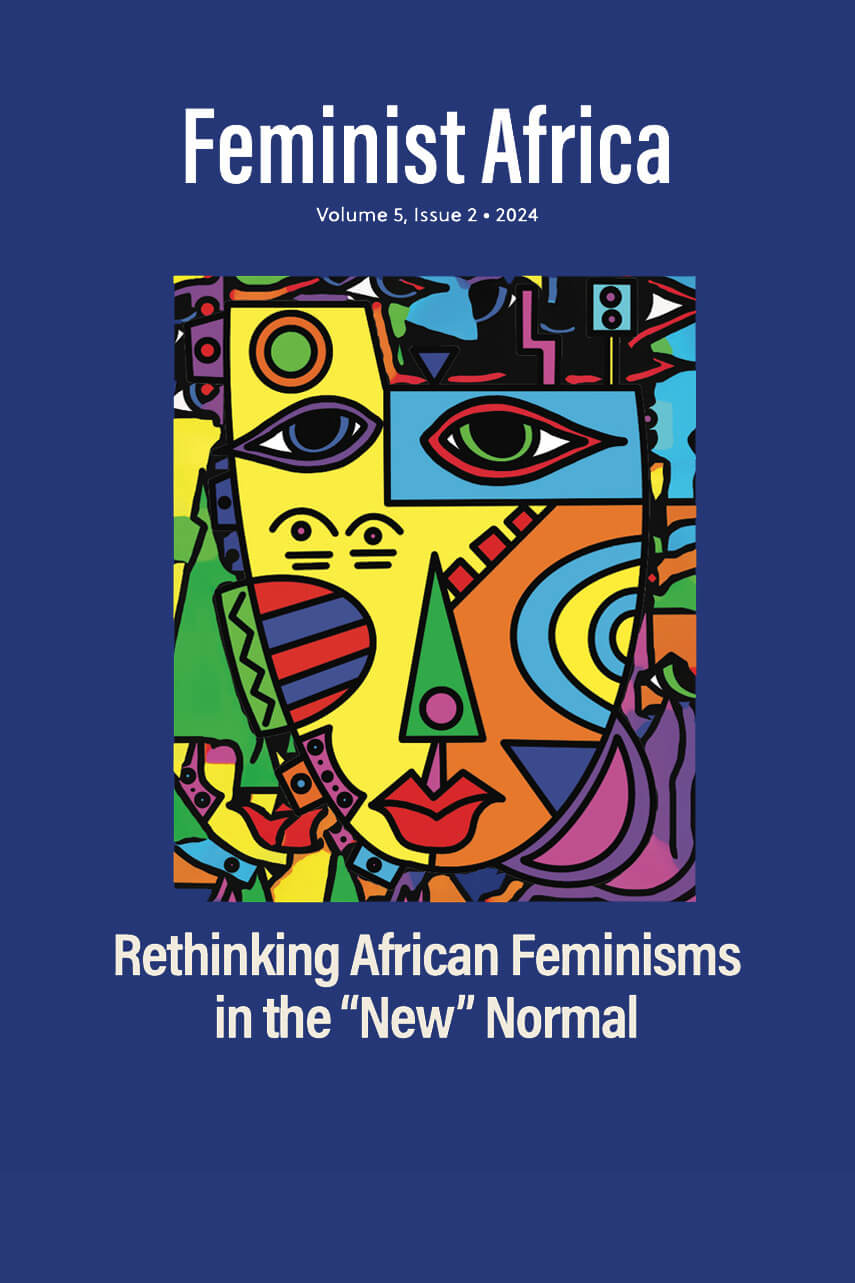
“Rethinking African Feminisms in the ‘New’ Normal”
Since the turn of the century, the world has changed radically, making it unrecognisable to…